
DRAFTING A PUBLICATION BUDGET
To calculate a draft publication budget, find below the correct cost per task and sum
+ the estimated editorial and production cost
+ graphics, if included
+ the honorarium
+ the print estimate
= estimated budget
Be in touch with any questions.
Editorial and production costs
Pages = SEK
04 pages = 14 809
08 pages = 20 970
12 pages = 31 456
16 pages = 37 617
20 pages = 43 779
24 pages = 49 941
28 pages = 56 103
32 pages = 66 588
36 pages = 72 750
40 pages = 78 911
44 pages = 85 073
50 pages = 95 558
60 pages = 107 882
70 pages = 120 205
80 pages = 132 529
100 pages = 157 176
If you will be including graphics, please review the options and costs here: SIPRI Graphics Service Packages.
Honorarium
Budget at least SEK 3000 for one external referee for every publication you seek to produce. If you think the paper will need more than one referee, budget more. If the paper will be over 40 pages, consider budgeting more.
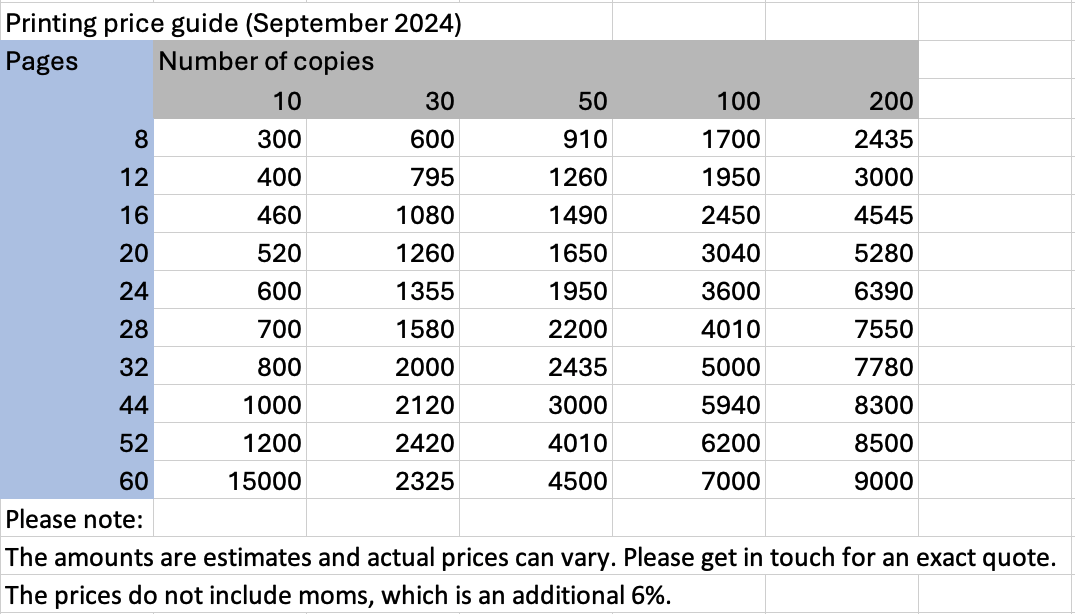
Printing costs
Dear Most Excellent Researcher,
Below is our standard “if you want a quick response from Outreach on your proposal, please send it like this” note. It would be super helpful when contacting me, Steph and Martina to extract and summarize what we need to know in the body text of the email.
It’s tricky to have to download the documents and skim through everything trying to shake out and triangulate all of the information relevant to our departments. Some funding documents are quite long, complex and relevant info is often dispersed in different places. This becomes a major obstacle to an otherwise super quick response. Reminder, we’re not just working with your application but those of the whole Institute.
It has been established that this kind of project-based summary that doesn’t link to people’s salary etc. As such it is okay to put the rough budget in the body of the email b/c the editing and production time are aggregate work categories spread out over a range of 3 to 5 people and the referee and printing costs are not linked to a person but the cost of an activity).
Please send something that looks like what is shown below. We understand everything is provisional.
e.g.
“Title of project”Researcher A/Researcher B/Researcher C (project runs 1 January 2023 and ending 31 December 2023)SIPRI Blog (insert headline topic)Budget = XXXGo live= May 2023 SIPRI Insights Paper (insert headline topic), 20ppEditing and production: 10 days at 5000 SEK/day = 50 000 SEKPrinting: 200 copies at 3125 SEK/100 copies = 6250 SEK
Honorarium = 3000 SEKTotal = 59 250 SEKGo live = May 2023SIPRI Policy Brief (insert headline topic), 8ppEditing and production: 5 days at 5000 SEK/day = 25 000 SEKHonorarium = 1500 SEK
Printing: 100 copies at 1250 SEK/100 copies = 1250 SEKTotal = 27 750 SEKGo live = mid November 2023
with virtual launch tied to a hard anniversary date with a social media campaign
Project lead is Researcher A (with support from B and C and other experts as necessary).
One in person workshop
A few relevant details as above with budget
One hybrid workshop
A few relevant details as above with budget
Two commentaries
A few relevant details as above with budget
One film
A few relevant details as above and budget
SELECTING A SIPRI FORMAT
Most SIPRI publications fall into one of categories below. Please ask Joey if the formats on offer do not seem to fit what you’re looking to publish.
Research-oriented formats
SIPRI Insights on Peace and Security
Outline new areas of research, with original analysis and findings or observations. Length: 8–20 pages (3150–8550 words, see notes below), plus 150-word summary. Max 28 pages.
SIPRI Background Papers
Provide overview of any subject of SIPRI research. These should simply recount information; if new analysis or recommendations are required, consider an Insights. Length: 8–20 pages (3150–8550 words, see notes below), plus 150-word summary. Max 28 pages.
SIPRI Fact Sheets
Present original SIPRI data or original collations of non-SIPRI information. Length: 2–8 pages (900–3600 words, see notes below), plus 120-word key facts. Max 8 pages.
Policy-focused formats
SIPRI Policy Briefs
Argue a convincing story advocating for specific lessons or lines of action based on SIPRI research, activities, knowledge and networks. Briefs are targeted at a policy audience and aim to contribute to an ongoing policy debate. Background text is limited: each brief should be presented in such a way that it can stand on its own, but appropriate references direct the readers to other relevant literature. ‘Other relevant literature’ can include the anchoring references to SIPRI-based research and findings. The Policy Brief format aptly complements other SIPRI formats (e.g. Insights, Background and Policy papers). Policy Briefs must contain recommendations. Length: 2–8 pages (900–3600 words, see notes below), plus 150-word summary. Max 8 pages. For guidance, see the separate document, SIPRI Policy Brief guidelines (PDF).
SIPRI Policy Research Papers
Similar to Policy Briefs in audience and aim, but they assume the reader wants more detail about the reasoning, research or findings informing the argumentation and recommendations. Research Policy Papers must contain recommendations. Length: 8–20 pages (900–3600 words, see notes below), plus 150-word summary. Max 28 pages.
SIPRI Policy Papers (the numbered series) or Policy Reports (A4 plain cover)
Similar to a Policy Briefs and Policy Research Papers but even more in-depth. Length: 20–50 pages (11 250–22 500 words), plus 800-word summary.
SIPRI Yearbook
The SIPRI Yearbook is an authoritative and independent source to which politicians, diplomats, scholars and journalists can turn for an account of what has happened during the year in: international security, armed conflicts, conflict resolution and security arrangements; military expenditure, the arms trade, arms production, weapons and technology; and efforts to control conventional, nuclear, chemical and biological armaments.
SIPRI monographs
SIPRI monographs can be on any subject of SIPRI research. The result of long-term, considered research; aim to set the standard for future research on their subject. May be multi-author collections. Published and distributed by Oxford University Press, these are 200–350 pages (c. 90 000–157 500 words); typically no more than 250 pages (112 500 words). Typical time from first complete draft to publication is around 18 months; a 250-page monograph at 400 copies would roughly cost SEK 770 000 SEK (including honorarium, editing, production, printing, shipping and distribution).
SIPRI Research Reports
A series of reports on urgent arms control and security subjects. Concise, timely and authoritative sources of information. New findings as well as easily accessible collections of official documents and data. Published and distributed by Oxford University Press, SIPRI Resarch Reports are 100–200 pages (45 000–90 000 words); typically no more than 150 pages (67 500 words); Typical time from first complete draft to publication is around 12 months; a 150-page research report at 400 copies would roughly cost SEK 440 000 SEK (including honorarium, editing, production, printing, shipping and distribution).
According to our agreement with Oxford University Press (OUP), all publications that ‘can reasonably be typeset to make a book of at least 100 pages’ can be considered for publication by OUP.
OTHER PUBLICATIONS
In general, we aim to publish all of SIPRI’s output in whatever form it needs to appear. While editorial can be contracted to work on such deliverables, please note that SIPRI does not publish external authors, edited volumes by majority external authors or conference/workshop reports, summaries, proceedings and other such similar.
NOTES
All work published by interns must be co-authored in-house.
Funder visibility requests/requirements (logo use, logo placement, language) related to SIPRI deliverables (including but not limited to publications) should be discussed and agreed with Outreach before any external agreement is made. If, when and how funder visibility is implemented should not be assumed. It is the responsibility of the author to provide necessary high-quality files and related-use information. Funder logos rarely appear on the front cover of any SIPRI publication.
All SIPRI (online and print) publications are subject to a robust review process that includes (a) internal review (i.e. within the project and cluster); (b) in-house review (i.e. SIPRI-wide, targeting specific relevant colleagues, including the Director and Deputy Director); and (c) external (peer) review. A decision to skip any of part of the review process can only be made by the Director of Studies. See also The review process.
WORD COUNT GUIDELINES
All word limits are estimates and include footnotes. Word count guidelines for pagination do not account for graphics or tables.
For calculating Policy Briefs and Fact Sheets
2pp = 900 words; 4pp = 1800 words; and 8pp = 3600 words
(12pp = 5400 words and 16pp = 7200 words — NB: These lengths are not recommended)
For calculating Insights and Background papers
4pp = 1350 words; 8pp = 3150 words; 12pp = 4950 words; 16pp = 6750 words; and 20pp = 8550 words
(24pp = 10 350 words and 28 pp = 12 600 words — NB: These lengths are not recommended)
NB: Copy-fitting is an art and not a science. Close word counts are often affected by the length of the title and subtitle; the number of authors (and their bios if included); the number and length of subheads; the use, size and placement of tables and figures plus their notes; the inclusion of logos and special notes etc.
Past or future practice that differs from these guidelines does not set a precedent. All times for editing and publication are estimates; actual time taken will depend on the state of the original manuscript (e.g. grammar and language usage, application of SIPRI house style etc.), the length of the publication, the speed of the reviewing process, the time that you have available for revisions and other Editorial Department commitments.